

By Dr. Carsten Sander Christensen
The Arctic, long considered a frozen and peripheral frontier, is undergoing a transformation so rapidly it is redrawing the maps of geopolitics, economics, and climate security. At the epicenter of this transformation lies Greenland—the world’s largest island, an autonomous territory within the Kingdom of Denmark—and the intricate triangular relationship between Nuuk, Copenhagen, and Washington, D.C. As the ice recedes, revealing new shipping lanes, untapped resources, and strategic chokepoints, the United States has dramatically recalibrated its Arctic policy. This article analyzes the evolving dynamics between the USA, Denmark, and Greenland, with a particular focus on the American approach to the “Arctic crisis,” examining its drivers, manifestations, and the complex challenges it poses to its smaller allies.
I. The Stakes: Why the Arctic is Now a Priority
The American re-engagement with the Arctic is not born of whimsy but of a stark reassessment of national interests in a changing world.
- Geostrategic Competition: The Arctic is a theater of great-power rivalry. Russia has militarized its Arctic coastline, reopened Soviet-era bases and deploying advanced anti-access systems. China, self-declared a “Near-Arctic State,” seeks influence through scientific investment, infrastructure projects, and resource diplomacy. For the U.S., maintaining freedom of navigation and denying adversaries strategic dominance in the region is a core Pentagon concern. The GIUK Gap (Greenland-Iceland-United Kingdom) remains a critical naval chokepoint for Atlantic access.
- Economic Potential: The U.S. Geological Survey estimates the Arctic may hold 13% of the world’s undiscovered oil and 30% of its natural gas, alongside vast deposits of rare earth elements, critical for modern technology and defense systems. Greenland’s subsurface is particularly rich in these minerals. Furthermore, the Northern Sea Route (along Russia) and the Northwest Passage (through Canada) promise to slash transit times between Asia, Europe, and North America, rewriting global trade logistics.
- Climate Security & Scientific Imperative: The Arctic is warming at four times the global average, acting as the planet’s air conditioner in rapid decline. Understanding these changes is critical for global climate modeling. The U.S. maintains vital scientific assets in Greenland, most notably the Thule Air Base, which also hosts space surveillance systems. Environmental changes directly impact U.S. coastal security and global stability.
II. The American Approach: “Strategic Competition” Meets “Persistent Engagement”
The U.S. response, crystallized under successive administrations but intensified since the late 2010s, is a multi-domain strategy that blends hard security, diplomatic maneuvering, and economic statecraft. Its handling can be characterized by several key aspects:
1.The Security-First Paradigme:
- Military Re-posturing: The U.S. has revived the Second Fleet (dissolved in 2011), tasked with Atlantic and Arctic operations. It conducts regular Freedom of Navigation Operations (FONOPs), exercises like Cold Response with NATO allies, and invests in ice-capable vessels. The 2019 deployment of a U.S. Navy warship to Thule for the first time since 1987 was a potent signal.
- Infrastructure Investment: The U.S. has committed significant funds to modernize its Arctic assets. The 2023 agreement with Denmark to invest in modernizing infrastructure at Thule Air Base and at the dual-use civilian/military airports in Kangerlussuaq and Nuuk is a prime example. This serves dual purposes: enhancing operational capability and providing tangible benefits to Greenland, thereby cementing partnership.
2.Diplomatic Re-engagement and Alliance Management:
- Elevating Denmark & Greenland: The U.S. has skillfully navigated the Kingdom’s unity. While Copenhagen handles foreign and security policy, the U.S. has opened a consulate in Nuuk (2020)—a move of profound symbolic importance, recognizing Greenland’s agency. High-level visits to Greenland by Secretaries of State (Pompeo, 2019; Blinken, 2023) underscore its direct strategic value.
- The “Trump Greenland Episode” as a Catalyst: The 2019 proposal to purchase Greenland, though crude and dismissed, had a seismic impact. It laid bare the raw strategic value Washington placed on the island, shocked the Danish political establishment into realizing the fragility of the status quo, and paradoxically empowered Greenland by making its consent indispensable for any future major agreement.
- Countering Chinese & Russian Influence: The U.S. has actively lobbied allies to exclude Chinese firms from critical infrastructure projects (e.g., airports, mining), citing security risks. It has also worked to integrate Greenland into Western supply chains for critical minerals, offering an alternative to Chinese financing.
3.Economic Statecraft as a Tool of Influence:
- Beyond security aid, the U.S. is promoting private-sector investment. The U.S. Export-Import Bank and Development Finance Corporation have been directed to support projects in Greenland and the wider Arctic that align with U.S. strategic interests, offering loans and guarantees that compete with Chinese state-backed finance.
- This approach aims to provide Greenland with a path to economic development that is tethered to the West, thereby securing its political alignment.
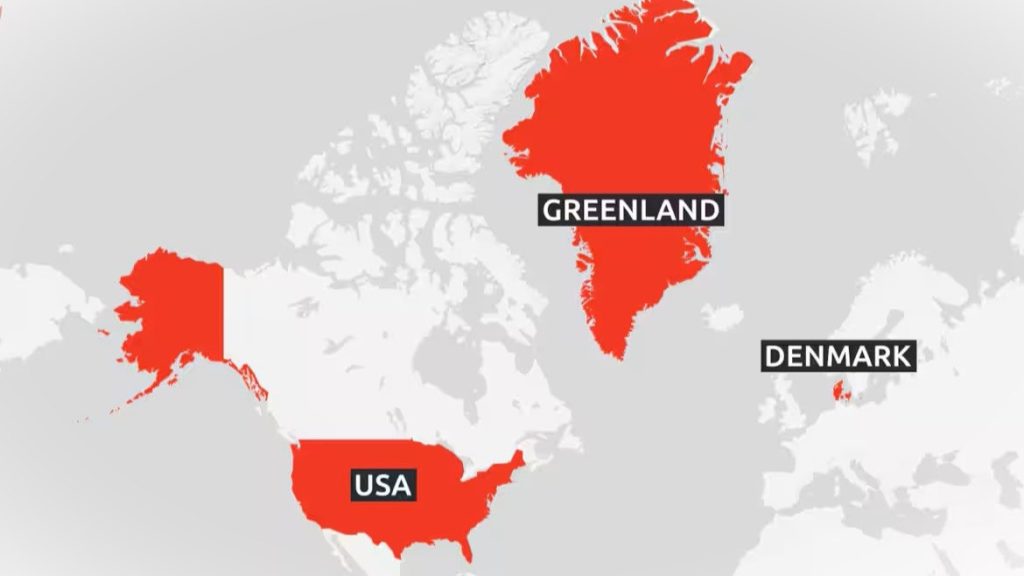
III. The Danish Dilemma: Ally, Sovereign, and Mediator
Denmark finds itself in a complex position: a steadfast NATO ally of the U.S., the sovereign responsible for Greenland’s defense, and a mediator between Washington’s global strategy and Nuuk’s local aspirations.
- The Atlanticist Anchor: Denmark is deeply committed to the transatlantic alliance. It welcomes the renewed U.S. commitment to Arctic security as a necessary counterbalance to Russia. Enhanced American presence in Greenland strengthens NATO’s northern flank and, by extension, Denmark’s own security.
- The Sovereignty Tightrope: The 1951 defense agreement that established Thule Air Base is a historical reminder of a time when Copenhagen could make decisions about Greenland with less consultation. Today, any significant U.S. military activity or expansion requires delicate negotiation with the Greenlandic Self-Rule Government. Denmark must balance its treaty obligations to the U.S. with its constitutional duty to represent Greenland’s interests, which are not always perfectly aligned.
- “The Kingdom Speaks with One Voice”: This is Copenhagen’s mantra. It seeks to present a unified front, managing foreign and security policy while ensuring Greenland (and the Faroe Islands) are heard. The 2023 airport investment deal is a successful example of this tripartite cooperation.
IV. Greenland’s Agency: Between Aspiration and Geopolitics
Greenland is no longer a passive object but an active subject in Arctic affairs.
- The Quest for Full Independence: The goal for most Greenlandic political parties is full sovereignty. Economic self-sufficiency is the stated prerequisite. This drives a keen interest in mining, tourism, and fisheries. The U.S. focus, while bringing investment, also creates a potential dependency that could complicate or delay the independence trajectory.
- Leveraging Geopolitical Interest: Greenlandic leaders are acutely aware of their newfound leverage. They can play suitors (U.S., EU, China, others) against each other to secure the best terms for development. However, this is a high-stakes game; overplaying their hand could lead to pressure or a withdrawal of critical support.
- The Social and Environmental Balance: There is deep domestic concern about the environmental impact of large-scale mining and military activity. The 2021 election, fought partly on the issue of a rare earths mining project, showed that economic promises do not automatically trump environmental and social concerns. The U.S. must navigate these domestic sensitivities.
Analysis: Strengths and Critiques of the American Approach
Strengths:
- Clarity and Commitment: The U.S. has brought decisive focus and resources to a neglected theater, reassuring allies in Northern Europe.
- Integrated Strategy: It successfully links security, diplomacy, and economics into a coherent framework.
- Empowerment of Greenland: By engaging directly with Nuuk, the U.S. acknowledges political realities and builds a more sustainable, consent-based partnership.
Critiques and Challenges:
- The Perception of Instrumentalization: There is a risk that Greenland is viewed primarily as a piece on a great-power chessboard—a “strategic asset” first and a society with its own future second. This can breed resentment.
- Inconsistency and Domestic Politics: The volatile nature of U.S. domestic politics can lead to policy swings (e.g., the Trump purchase offer) that undermine trust and long-term planning for Nuuk and Copenhagen.
- Underplaying the Climate Crisis: Critics argue the U.S. focus on competition often overshadows the existential climate driver of the Arctic transformation. Leadership in mitigation and adaptation is seen as lacking, creating a paradox where the U.S. militarizes in response to a crisis it is not doing enough to solve.
- Straining the Danish Greenlandic Bond: Overly assertive U.S. overtures to Nuuk could strain the unity of the Kingdom, forcing difficult choices between Copenhagen’s alliance obligations and its role as the sovereign power.
Navigating the Thaw
The Arctic crisis is a confluence of climate change and geopolitics. The American way of handling it is a classic great-power response: securitization, alliance reinforcement, and economic statecraft to shape the region in its favor. While effective in re-establishing a deterrence posture and offering an alternative to Chinese influence, this approach is not without friction. The long-term stability of the Arctic will depend not just on military balances but on sustainable partnerships that respect the agency of Arctic communities. For the U.S., success will be measured not only by its ability to keep adversaries at bay but by its capacity to be a reliable partner to Denmark and Greenland—one that supports Greenland’s lawful economic aspirations, respects its environmental vulnerabilities, and ultimately contributes to a stable, rules-based Arctic order. The melting ice is revealing not just new resources, but the true test of 21st-century statecraft: managing competition while fostering cooperation in a world of shared, if unequal, vulnerability. The triangle between Washington, Copenhagen, and Nuuk will be a defining case study in whether this balance can be achieved.