
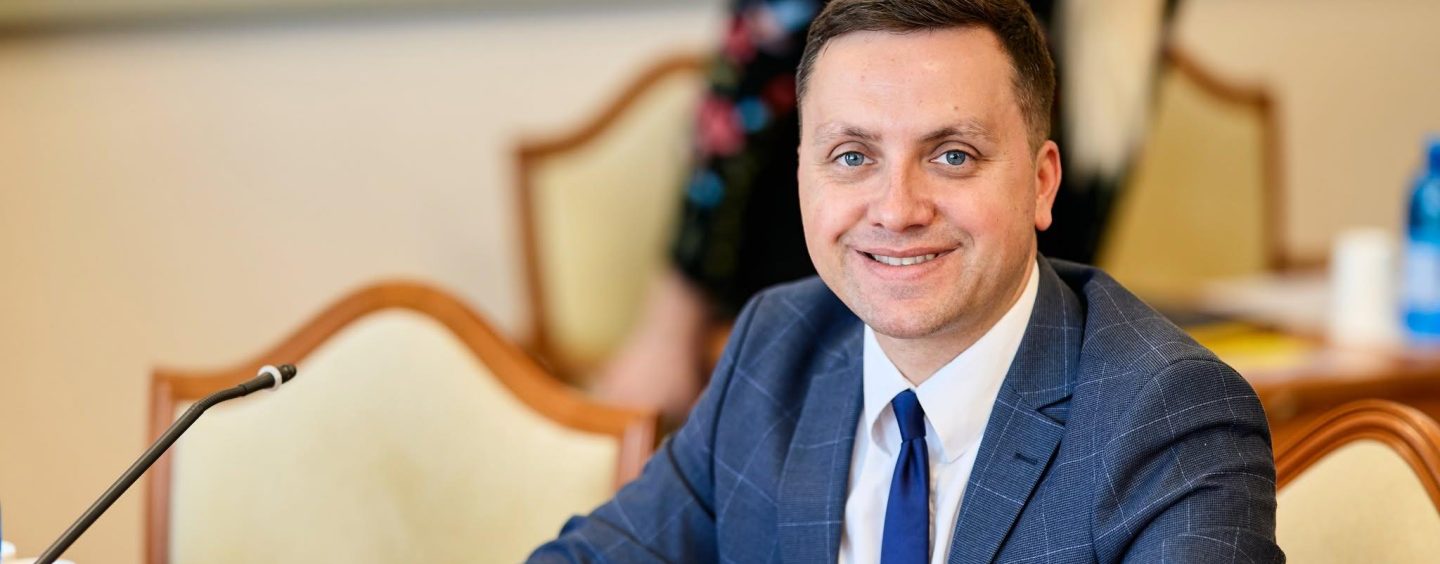
The Strategic Partnership Between Ukraine and Azerbaijan is Going Through a Truly Landmark Stage of its Development
An Interview with Mr. Volodymyr Kreidenko, Member of the Parliament of Ukraine and Co-Chair of the Verkhovna Rada’s Interparliamentary Relations Group with the Republic of Azerbaijan for Azerbaijan Today Magazine.
Questions prepared by Carsten Sander Christensen
A.T.: Ukraine and Azerbaijan have significantly deepened their strategic partnership in recent years, particularly in defense and military-industrial cooperation. How do you envision the future of this partnership, and what new areas of cooperation do you see emerging over the next five years?
V.K.: The strategic partnership between Ukraine and Azerbaijan is going through a truly landmark stage of its development. Thanks to the personal efforts of President of Ukraine Volodymyr Zelenskyy and President of Azerbaijan Ilham Aliyev, our relations have reached a qualitatively new level – a level of genuine strategic interaction, built on shared values, mutual respect, and a long-term vision. Both leaders have repeatedly reaffirmed their commitment to strengthening bilateral ties, and this gives us a powerful political impetus for further work.
As for the prospects over the next five years, I see several key directions. First, the development of joint projects in the field of unmanned systems and modern defence technologies. Second – the intensification of industrial cooperation, particularly in the production of ammunition and electronic warfare systems. Additionally, deepening interaction in the area of cybersecurity and intelligence sharing within the framework of international law is of great importance. Our potential for partnership is enormous, and we are obliged to realise it for the benefit of both nations.
I also want to emphasise that I sincerely hope for the active participation of Azerbaijani businesses in the post-war reconstruction of Ukraine. Azerbaijani companies have considerable experience in implementing large-scale infrastructure projects, and we are ready to create the most favourable conditions possible for their work in the Ukrainian market. Ukraine’s recovery is not only our national duty – it is also a broad economic opportunity for the partners who will come alongside us to build the future.
A.T.: The two countries have signed agreements on joint defense production and cooperation in unmanned systems. How can Ukraine and Azerbaijan further develop their defense-industrial partnership while contributing to regional stability and security?
V.K.: The signed agreements on joint defence production and cooperation in the field of unmanned systems are not merely diplomatic documents – they are a concrete foundation for building a shared security space. Ukraine has accumulated invaluable experience in the development and combat application of unmanned aerial vehicles in conditions of real conflict. This experience, combined with Azerbaijani expertise and technological capabilities, has the potential to generate a synergistic effect that benefits both sides.
To further develop the defence-industrial partnership, we must first formalise the mechanisms for joint research and development activities. We should consider the possibility of establishing joint ventures in the production of drone components, and also invest in shared training programmes for technical specialists.
A.T.: Azerbaijan has become an increasingly important energy partner for Ukraine, especially regarding gas supplies and energy infrastructure support. What role do you see Azerbaijani energy resources playing in Ukraine’s long-term energy security strategy and its closer integration with European energy markets?
V.K.: The issue of energy security has become critically important for Ukraine since the beginning of the full-scale invasion. In this context, Azerbaijan is emerging not merely as a supplier of resources, but as a strategic partner in shaping a new energy architecture – one free from dependence on Russian energy.
Azerbaijani natural gas is already flowing to Europe through existing infrastructure. I believe we should work together to expand the capacity of existing corridors to facilitate a potential transit role for Ukraine in supplying Azerbaijani gas westward. Furthermore, there are prospects for developing cooperation in the field of renewable energy – particularly green hydrogen, where both countries have significant potential. Ukraine’s integration into the unified EU energy market opens opportunities for attracting Azerbaijani investment into Ukrainian energy infrastructure, and this is a direction that should be actively pursued at the parliamentary level.
A.T.: Azerbaijan has provided substantial humanitarian assistance and is participating in reconstruction projects, including in the city of Irpin. Which sectors of Ukraine’s reconstruction would most benefit from further Azerbaijani participation, and how can parliamentary cooperation facilitate this process?
V.K.: Azerbaijan’s humanitarian assistance and participation in the reconstruction of the city of Irpin is not only a practical contribution to our country’s recovery – it is a powerful symbolic gesture of solidarity that is deeply valued by Ukrainian society. Irpin has become a symbol of our resistance and resilience, and the fact that Azerbaijan has joined in its reconstruction speaks to a genuine partnership.
When it comes to sectors where Azerbaijani participation could have the greatest impact, I would highlight several priority directions. These include the restoration of housing and social infrastructure – schools, hospitals, kindergartens. Next – the modernisation of energy infrastructure: substations and heating networks that have been subjected to systematic strikes. Also important is the rebuilding of logistics infrastructure – bridges, roads, and key transport hubs. Finally – the introduction of modern ‘smart city’ technologies in the reconstruction process, so that what was destroyed becomes better than it was before. The parliamentary friendship group plays the role of a catalyst here: we can facilitate the creation of a legislative framework that simplifies the involvement of foreign investors in reconstruction projects.
A.T.: Ukraine and Azerbaijan have consistently supported each other’s sovereignty and internationally recognized borders. How important is this shared commitment to international law in shaping bilateral relations and cooperation within regional organizations?
V.K.: Our shared commitment to the principles of sovereignty and respect for internationally recognised borders is the fundamental foundation of our relations – not merely declaratory, but real and effective. Both of our countries have learned from their own experience what it means for these principles to be violated by a neighbour. This shared fate gives rise to a mutual understanding.
Our mutual support in relevant votes at the UN General Assembly, our aligned position within organisations where both countries are represented – none of this is a coincidental convergence of interests. It is a conscious, principled stance rooted in the understanding that security is indivisible. If international law is violated in one place without consequences, it is an invitation to violate it elsewhere. Therefore, our cooperation in regional and international organisations in upholding the norms of international law is not merely a bilateral matter, but a contribution to the formation of a more just and predictable world order.
A.T.: As Co-Chair of the Ukrainian Azerbaijani Friendship Commission, how do you assess the role of parliamentary diplomacy in strengthening relations between the two countries? What initiative is the Commission currently pursuing to expand cooperation in areas such as trade, education, culture, and security?
V.K.: Parliamentary diplomacy is a unique and often underappreciated instrument of international cooperation. Unlike formal governmental negotiations, parliamentary dialogue is characterised by greater openness, flexibility, and the ability to address topics that do not always fit within the rigid frameworks of official diplomacy. The Parliamentary Friendship Group for Inter-Parliamentary Relations with the Republic of Azerbaijan serves as a living bridge between the legislative bodies of our two countries.
Among the initiatives our parliamentary group is currently working on: first, the development of a memorandum on trade and economic cooperation that would remove regulatory barriers to bilateral trade. Second, the expansion of academic exchange programmes between universities in Ukraine and Azerbaijan – young people are the guarantee of a lasting partnership. Third, we are working to expand our cultural presence: organising exhibitions, film festivals, and artistic residencies that introduce our peoples to one another. Fourth – and this is perhaps the most pressing today – we are establishing a mechanism for regular consultations between the relevant committees of our parliaments on security legislation. I am convinced that our Parliamentary Friendship Group of the Verkhovna Rada of Ukraine for Inter-Parliamentary Relations with the Republic of Azerbaijan is one of the most effective engines of Ukrainian-Azerbaijani relations, and we have every opportunity to work with even greater dynamism.


